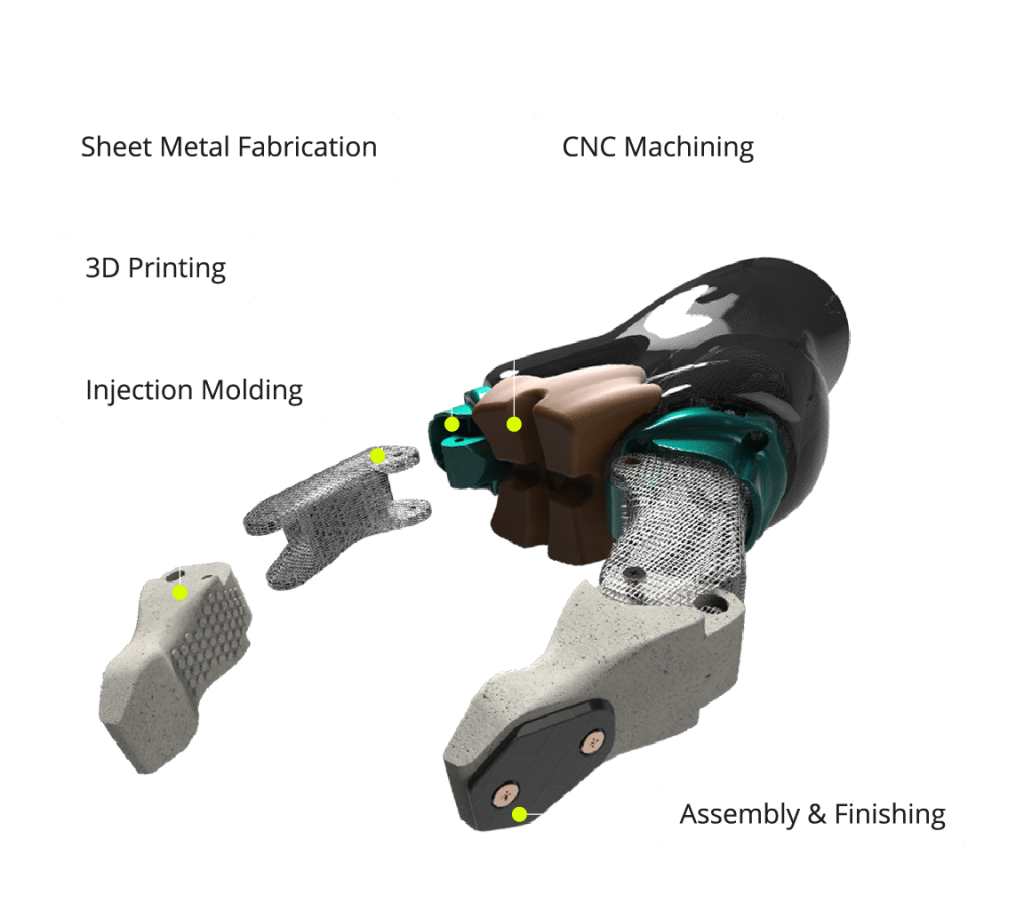
“Working with Fathom has given us a level of supply chain control we haven’t had with other partners. Instead of juggling multiple suppliers for machining, sheet metal, extrusions, and 3D-printed prototypes, we can run everything through one team and that’s been a huge advantage for our EV programs. Their engineers helped us tighten up a machined cooling-plate design, turn around sheet metal brackets in days, and rapidly iterate several 3D-printed enclosure concepts early in development. Having all of these capabilities under one roof has reduced delays, improved consistency across assemblies, and cut a significant amount of coordination time on our side.”
Senior Manufacturing Engineer,
Major EV OEM
“I’m impressed with your quality, expertise, speed, and customer service.”
Professor James F. Antaki, PhD
Carnegie Mellon University
“The team at Fathom continues to provide us with great service. Starting with initial DFM reviews, fast tooling development and quick turn-around times, Fathom is a partner keeping us on track to deliver quality products to our customers. Thank-you to all the Fathom team.”
Tim Latham, Project Manager
Litepanels, Inc.
“We have been very satisfied with Fathom’s performance in every aspect: pricing, delivery, quality, and customer support. It is a pleasure doing business with Fathom, and honestly, I wish there were more companies like them.”
Mark Merg, Procurement Manager
Alpha High Theft Solutions
“I want to thank you and the rest of the team for the great support. Over the 15 years that I have been working with mold vendors I have never seen such personal attention and such great communication efforts in addressing my concerns on samples. The fact that Fathom went the extra step to provide me with a second set of samples at no cost and in two days to improve my texture concerns goes a long way. I know that I have made the right choice going with Fathom. I’m looking forward to a long relationship with you and the rest of the Fathom team.”
“It is exactly what we were expecting. Well done to the team!”
Harwood Laskin
Schneider Electric
“This is a huge milestone for our team. This product is no longer a vision… I received the parts today from Fathom. They look and function great! I don’t see any reason why we cannot move forward now and order parts for the upcoming proto build.”
Dave Boretti
Schneider Electric
“As a small, growing company, we cannot say enough good things about Fathom. They have been willing and able to adapt to our rapidly changing needs and have helped us get out of a pinch on occasion. Special thanks to Brian and Carla – they have been great to work with!”
“It has been a genuine pleasure dealing with the Fathom team. You have been very patient and have been a wealth of helpful information. Your response times to my questions and comments are superb and your answers are specific and to the point. Thanks for your patience and all the time it has taken to get the details worked out.”
“I have to say that so far I’ve enjoyed this process – having the customer portal (and your well-detailed DFM reports) makes it very easy to comply with the design requirements.”
“I just wanted to let you know, we have all been very impressed with the quality and turnaround time of our parts. We have used several shops in the past, but so far the quality of Fathom has been the best we have ever received.”
“I just want to compliment you and your team how you are managing this project with all of the changes on the fly. Kudos.”
Mark Ezzo, Plastics and Composites Engineer
Materials & Chemistry Network of Excellence
“Our SteriPen product must meet the quality standards of a medical device — if it ever malfunctions, people will get sick. Yet it must be economical enough to permit many people to own one. And we need the design flexibility to keep pace with rapidly changing technology. Our production at ICO meets all three challenges.”
Don Snoke, VP of Operations
Hydro-Photon, Inc.
“After reaching out to over 20 manufacturers, Fathom was the only one that was able to take on my project, create the molds and manufacture the parts I needed. What impressed me the most is that they were able to work overtime to meet my demanding deadline and get the parts to me on time.”
Aziz Razakov,
Berry Good Bottle
“I found it refreshing to work with a company with such a phenomenal online quoting tool. It allowed us to experiment with different materials, quantities, and mold configurations to see the cost impact in real time.”
Mike Yin, Founder
Nunchuck Grips LLC
“The parts came in a few days ago and I wanted to thank you and your team on the very impressive quality of the parts. We were thoroughly impressed by the finish and clearness of the parts. Thank you for the great customer service and we are looking forward to using your expertise in future projects.”
Akash Shankar
PMC Smart Solutions
“We appreciate the effort you put into making our order smooth. The molded parts are used in our device that makes water safe to drink in areas of the world that do not have access to safe water. Thanks again for everything!”
“Fathom brings an open mind to each project with a positive attitude to tailor their processes to meet my needs, from part design to mold build and molding. They work hard to make sure my needs are met with a professional attitude, expertise, on-time delivery and competitive pricing.”
Bob Rohr
RDR Design and Development LLC
“No matter how complex or how new issues are with product design, we can always count on Fathom. Their team provides an unbiased, ‘out-of-the-box’ professional opinion that is always forward-thinking, interesting and helpful. We value their exemplary commitment to providing superb engineering.”
“It is a pleasure to work with a company whose personnel are willing and able to think out of their box. With your commitment to staying on the cutting edge of technology, you supply tooling to us that is right on time and works first shot.”
Norman R. Akens
Medical Murray
“Quick response time for RFQ, excellent lead time for rushed order and quality parts were manufactured and delivered on-time.”
Manufacturer of Compressed Gas Storage Systems
“The workmanship was outstanding – we are over-the-top happy with the unit! The product that arrived at my door far exceeded our expectations, and all on short notice…amazing. Please pass our very best wishes on to everyone on your team who was involved in fast-tracking our prototype. It all started with you and your can-do attitude, Nate. I cannot thank you enough!”
“Fit and finish is great and the parts passed all our regulatory tests. Thank you for all your help and for the role you played helping the factory work through some of the stickier parts of the design.”
“As a small, growing company, we cannot say enough good things about Fathom. They have been willing and able to adapt to our rapidly changing needs and have helped us get out of a pinch on occasion.”
M. Nasilevich
Morpho Detection
“I was very impressed with your company’s ability and willingness to work with a novice in plastics as I am, and work through some design changes. I have learned a lot from you and hope this is a huge success for both of us. Frankly, I did contact two other companies and they acted like they had no time for me!”
“We are very pleased. Response time is fantastic, customer support is great, and the online group project management tool is very helpful.”
Connie Blevins, Quality Coordinator
Leprecon